
Test Your Native IQ:
A 10-Item Quiz
Source Notes
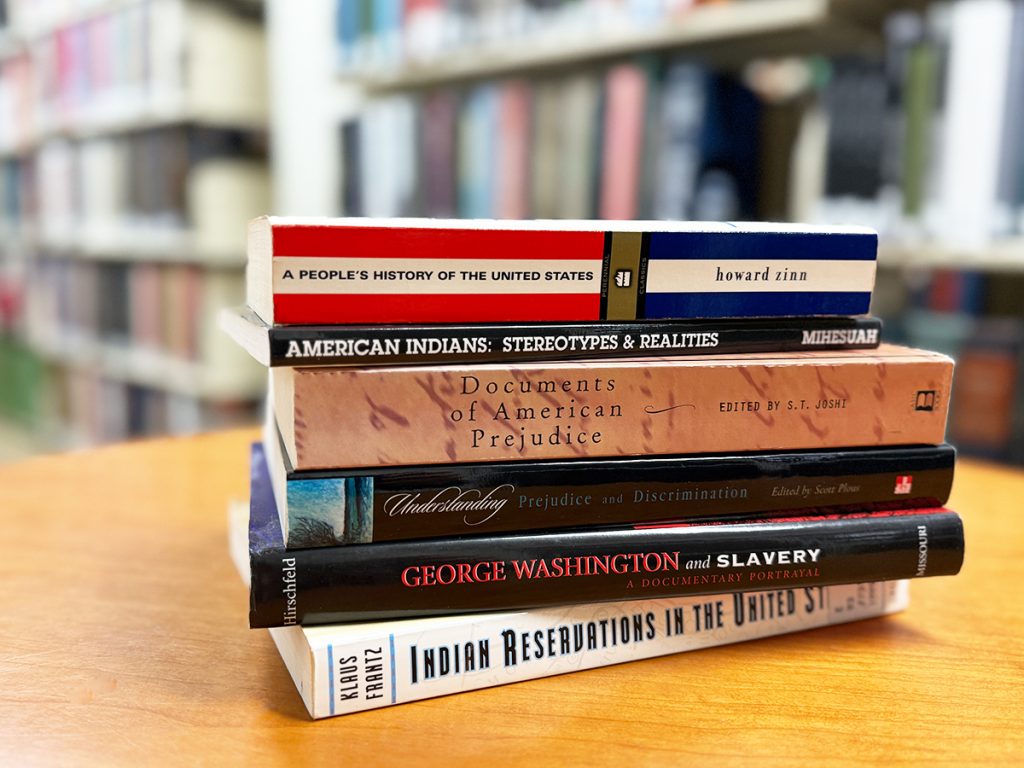
The notes below contain page numbers and complete reference citations for each item of the Native IQ Test.
Although we do not have sufficient resources to answer requests for further information about the test items, all source materials should be readily obtainable through most university libraries. You may also wish to visit Christopher Columbus: The Untold Story.
Question 1: Some Historical Context
- Page 339 of Plous, S. (Ed.). (2003). Understanding prejudice and discrimination. McGraw-Hill.
Question 2: What Christopher Columbus Wrote
- Page 327 of Plous, S. (Ed.). (2003). Understanding prejudice and discrimination. McGraw-Hill.
- Page 22 of Blackhawk, N. (2023). The rediscovery of America: Native peoples and the unmaking of U.S. history. Yale University Press.
- Page 69 of Williams, E. (1963). Documents of West Indian history (Vol. I, 1492-1655: From the Spanish discovery to the British conquest of Jamaica. PNM Publishing Co.
- Pages 1 and 4 of Zinn, H. (1999). A people’s history of the United States: 1492-present. Perennial Classics.
Question 3: The Practice of Scalping
- Liles, J. (2025, April 28). Family of woman photographed in 1944 allegedly writing thank-you note for Japanese soldier’s skull speaks out. Snopes.
- Picture of the week. (1944, May 22). Life, pp. 34-35.
- Pages 163 and 330 of Plous, S. (Ed.). (2003). Understanding prejudice and discrimination. McGraw-Hill.
- Page 72 of Zinn, H. (1999). A people’s history of the United States: 1492-present. Perennial Classics.
Question 4: The Declaration of Independence
- Pages 361-362 of Adams, C. F. (Ed.). (1856). The works of John Adams, second president of the United States: With a life of the author, notes and illustrations, by his grandson (Vol. 10). Little, Brown and Company.
- Page 319 of Ford, P. L. (Ed.). (1895). The writings of Thomas Jefferson (Vol. 5). G. P. Putnam’s Sons.
- Page 331 of Plous, S. (Ed.). (2003). Understanding prejudice and discrimination. McGraw-Hill.
- Pages 541 and 904 of Washington, G. (1997). Writings. Library of America.
Question 5: Indian “Removal”
- Page 33 of Jackson, A. (1900). Fifth annual message (1833, December 3). In J. D. Richardson (Ed.), A compilation of the messages and papers of the presidents, 1789-1897 (Vol. 3, pp. 19-35). Bureau of National Literature and Art.
- Pages 519-520 of Jackson, A. (1901). Second annual message (1830, December 6). In J. D. Richardson (Ed.), A compilation of the messages and papers of the presidents, 1789-1897 (Vol. 2, pp. 500-529). Bureau of National Literature and Art.
- Pages 616 and 618 of Van Buren, M. (1900). Fourth annual message (1840, December 5). In J. D. Richardson (Ed.), A compilation of the messages and papers of the presidents, 1789-1897 (Vol. 3, pp. 602-620). Bureau of National Literature and Art.
- Pages 497-500 of Van Buren, M. (1900). Second annual message (1838, December 3). In J. D. Richardson (Ed.), A compilation of the messages and papers of the presidents, 1789-1897 (Vol. 3, pp. 483-505). Bureau of National Literature and Art.
- Pages 1 and 4 of Zinn, H. (1999). A people’s history of the United States: 1492-present. Perennial Classics.
Question 6: Suicide Attempts by Young People
- Page 1 of Alaska Native Tribal Health Consortium. (2021). Suicide mortality. Alaska Native Health Status Data Fact Sheet 2021.
- Page 227 of Price, J. H., & Khubchandani, J. (2025). Suicidal thoughts and behaviors in American Indian and Alaska Native adolescents. Journal of Community Health, 50, 227-234.
Question 7: Residential Segregation
- Page 170 of Plous, S. (Ed.). (2003). Understanding prejudice and discrimination. McGraw-Hill.
Question 8: American Citizenship
- Page 29 of Frantz, K. (1999). Indian reservations in the United States: Territory, sovereignty, and socioeconomic change. University of Chicago Press.
- Page 330 of Plous, S. (Ed.). (2003). Understanding prejudice and discrimination. McGraw-Hill.
- Page 2 of U.S. Senate Select Committee on Indian Affairs. (1988). H. Con. Res. 331. (100th Congress, 2nd Session, January 25 – October 22, 1988, Serial Number 13866, Report 100-565). U.S. Government Printing Office.
Question 9: Statistics on Indian Reservation Life
- Page 53 of Akee, R., Moreno, E., & Medford, A. B. (2025, September). Social and economic changes in American Indian reservations: A databook of the U.S. Census and the American Community Survey, Third Edition, 1990–2020. The Harvard Kennedy School Project on Indigenous Governance and Development.
- Pages 4-5 of Haslam, B. (2024, May). Unemployment on Native American reservations. Ballard Brief.
- Howard, L. (2022, August 25). Addressing water and wastewater challenges in tribal nations. Administration for Children & Families, U.S. Department of Health & Human Services.
- Maxim, R., Akee, R., & Sanchez, G. R. (2022, February 9). For the first time, the government published monthly unemployment data on Native Americans, and the picture is stark. Brookings.
- Schering, S. (2025, September 9). Child poverty rate remains steady as disparities continue. AAP News.
- Page 51 of U.S. Department of Energy. (2023, August). Tribal electricity access and reliability report to Congress.
Question 10 : Congenital Syphilis
- Lowell, C. (2024, March 21). Native Americans are hardest hit by syphilis surge. NPR.
- Mandavilli, A. (2024, January 31). Syphilis cases soar in U.S., rising by 80% since 2018. New York Times, p. A15.
- Page 4 of South Dakota Department of Health. (2024, January). American Indian Health Data Book: Selected Health Concerns in South Dakota.