
Slavery and the
U.S. Presidents
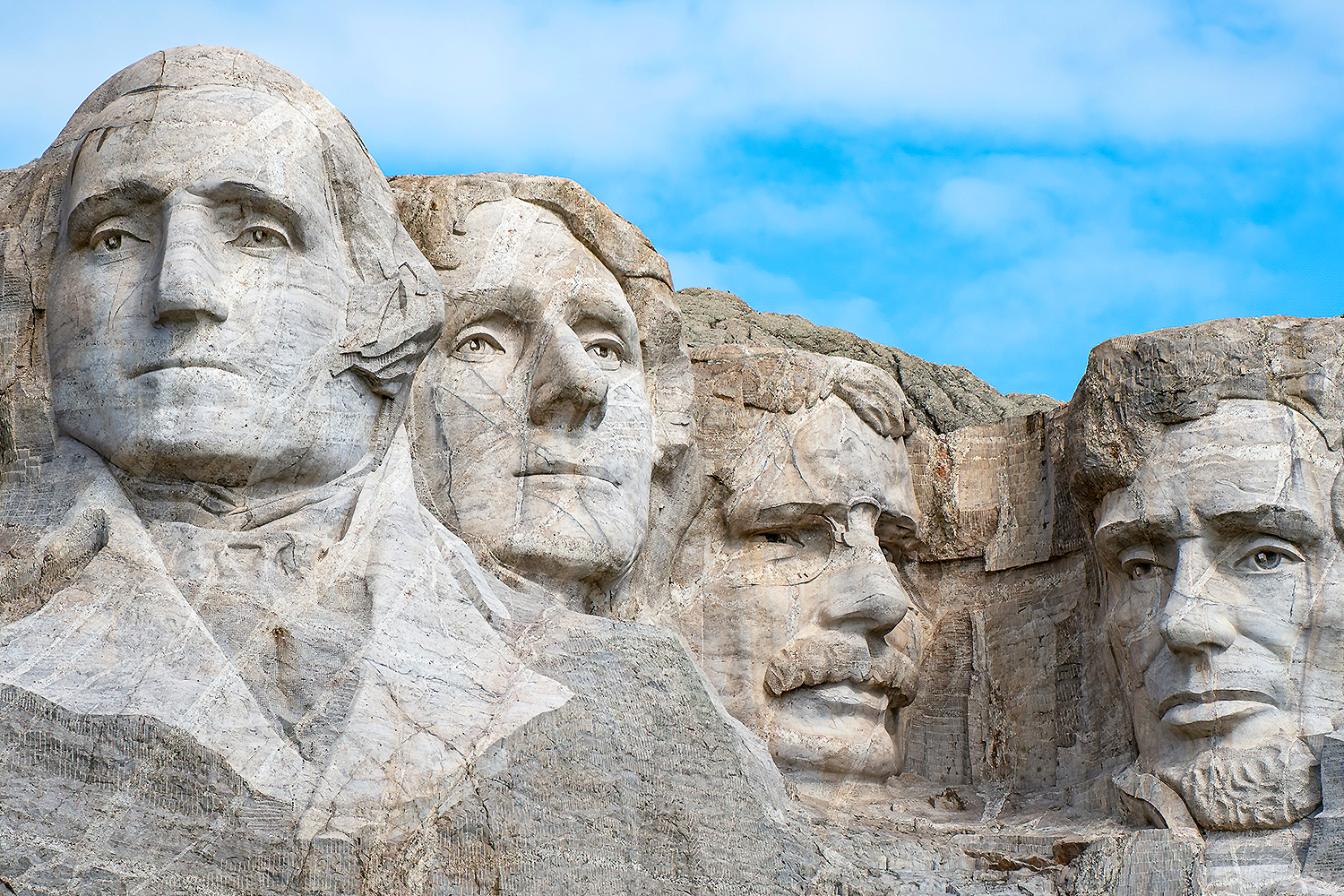
Peak Number of Slaves Held by Presidents
Washington was one of the largest slaveholders:
Pages 130-131 and 138 of Dalzell, R. F., Jr., & Dalzell, L. B. (1998). George Washington’s Mount Vernon: At home in revolutionary America. New York: Oxford University Press.
James Polk and Andrew Jackson used the basement:
Pages 181 and 257 of Seale, W. (1986). The president’s house: A history (vol. 1). Washington, DC: White House Historical Association.
Zachary Taylor had 15 slaves:
Page 282 of Seale, W. (1986). The president’s house: A history (vol. 1). Washington, DC: White House Historical Association.
During the presidency of Thomas Jefferson:
Page 101 of Seale, W. (1986). The president’s house: A history (vol. 1). Washington, DC: White House Historical Association.
Peak slave holdings of George Washington:
Pages 130-131 of Dalzell, R. F., Jr., & Dalzell, L. B. (1998). George Washington’s Mount Vernon: At home in revolutionary America. New York: Oxford University Press. [Washington’s 317 slaves, enumerated in a 1799 inventory entitled “NEGROES Belonging to George Washington in his own right and by Marriage,” included “dower” slaves from his wife’s family and 40 slaves attached to a lifetime rental property. See pages 18-19 of Hirschfeld, F. (1997). George Washington and Slavery: A documentary portrayal. Columbia, MO: University of Missouri Press.]
No slave holdings by John Adams:
Page 134 of McCullough, D. (2001). John Adams. New York: Simon & Schuster. [See also page 380 of Adams, C. F. (Ed.). (1856). The works of John Adams, second president of the United States (vol. 10). Boston: Little, Brown and Company.]
Peak slave holdings of Thomas Jefferson:
Slave Demographic Database, Monticello Research Department, as compiled by Monticello Senior Research Historian Lucia C. Stanton, March 28, 2002 [Note: According to historian Paul Finkelman, Jefferson owned roughly 200 slaves at the time of his death and at least 330 over his lifetime. See page 218, note 108 of Finkelman, P. (1993). Jefferson and slavery. In P. S. Onuf (Ed.), Jeffersonian legacies (pp. 181-221). Charlottesville, VA: University of Virginia Press.]
Peak slave holdings of James Madison:
Page 12 of Ketcham, R. (1971). James Madison: A biography. New York: Macmillan.
Peak slave holdings of James Monroe:
Page 264 of Gawalt, G. W. (1993, April). James Monroe, presidential planter. Virginia Magazine of History and Biography, 101, pp. 251-272.
No slave holdings by John Quincy Adams:
Page 430 of Nevins, A. (Ed.). (1960). The diary of John Quincy Adams, 1794-1845: American diplomacy, and political, social, and intellectual life, from Washington to Polk. New York: Frederick Ungar Publishing Co. [See also page 33 of Booker, C. B. (2000). African-Americans and the presidency: A history of broken promises. New York: Franklin Watts.]
Peak slave holdings of Andrew Jackson:
Page 30 of Walker, A. (1943). Andrew Jackson: Planter. East Tennessee Historical Society’s Publications, 15, 19-34.
Peak slave holdings of Martin Van Buren:
Page 385 of Niven, J. (1983). Martin Van Buren: The romantic age of American politics. New York: Oxford University Press.
Peak slave holdings of William Harrison:
Page 434 of Green, J. A. (1941). William Henry Harrison: His life and times. Richmond, VA: Garrett and Massie.
Peak slave holdings of John Tyler:
Page 300 of Seager, R., Jr. (1963). And Tyler too: A biography of John & Julia Gardiner Tyler. New York: McGraw-Hill.
Peak slave holdings of James Knox Polk:
Personal communication from Wayne Cutler, Professor of History and Editor of the Polk Project, University of Tennessee–Knoxville, January 25, 2002 [Note: Professor Cutler’s estimate is based on an 1843 tax record (the last available before Polk died in 1849). A somewhat higher estimate is contained in Bassett, J. S. (1925/1968). The Southern plantation overseer as revealed in his letters. Westport: Negro Universities Press.]
Peak slave holdings of Zachary Taylor:
Page 27 of Smith, E. B. (1988). The presidencies of Zachary Taylor & Millard Fillmore. Lawrence, KS: University Press of Kansas. [Note: Taylor is quoted as claiming to own 300 slaves on page 208 of McKinley, S. B., & Bent, S. (1946). Old rough and ready: The life and times of Zachary Taylor. New York: Vanguard Press. This claim is contradicted, however, by several other credible sources, including: Page 320 of Bauer, K. J. (1985). Zachary Taylor: Soldier, planter, statesman of the old southwest. Baton Rouge, LA: Louisiana State University Press. Page 145 of Currie, S. (Ed.). (1984). Zachary Taylor, plantation owner. Civil War History, 30, 144-156. Pages 18, 31, 33, and 180 of Holman, H. (1951). Zachary Taylor: Soldier in the White House. Indianapolis, IN: Bobbs-Merrill Company.]
No slave holdings by Millard Fillmore:
Page 431 of Severance, F. H. (Ed.). (1907). Millard Fillmore papers (vol. 1). Buffalo, NY: Buffalo Historical Society.
No slave holdings by Franklin Pierce:
Page 24 of Bell, C. I. (1980). They knew Franklin Pierce (and others thought they did). Springfield, VT: April Hill Publishers.
Peak slave holdings of James Buchanan:
Page 100 of Klein, P. S. (1962). President James Buchanan: A biography. University Park, PA: Pennsylvania State University Press. [Note: Buchanan bought two slaves from his brother-in-law in order to free them. The terms stipulated that one of the slaves would be free after a 7-year period of service to Buchanan, and the other would be free after a 23-year period of service.]
No slave holdings by Abraham Lincoln:
Page 24 of Donald, H. D. (1995). Lincoln. New York: Simon & Schuster.
Peak slave holdings of Andrew Johnson:
Page 45 of Trefousse, H. L. (1989). Andrew Johnson: A biography. New York: W.W. Norton.
Peak slave holdings of Ulysses Grant:
Page 62 of McFeely, W. S. (1981). Grant: A biography. New York: Norton. [Note: Of the five slaves owned by Ulysses Grant and his wife Julia, Grant held the title to one (William Jones), and the others belonged to his wife.]