

College Classroom Activities
Segregation Dynamics
Goal
To show how even mild affiliative preferences (e.g., to sit, live, or work near people like oneself) at the individual level can lead to surprisingly strong patterns of segregation at the group level, without any intentional desire or plan for segregation
Web-Based Version
Activity

If you have an Internet connection and classroom projector, begin by displaying the UnderstandingPrejudice.org interactive exercise entitled Can You Avoid Segregation? Then step through each of the exercise’s 6 pages as time permits, summarizing the key points and inviting students to suggest moving “unhappy” tokens to squares that will make the green tokens (majority members) and blue tokens (minority members) happy, as described on pages 2 and 5 of the exercise.
One advantage of the Web-Based Version of this exercise—compared with the Overhead Projector Version described below—is that the board play can be completed more quickly using the AutoComplete, thereby giving you time to run through multiple trials or change the settings to show how certain factors affect segregation. In addition, the Web-Based Version illustrates how the dynamic can be reversed to create integration rather than segregation.
Overhead Projector Version
Materials and Equipment
This classroom activity requires:
- An overhead projector
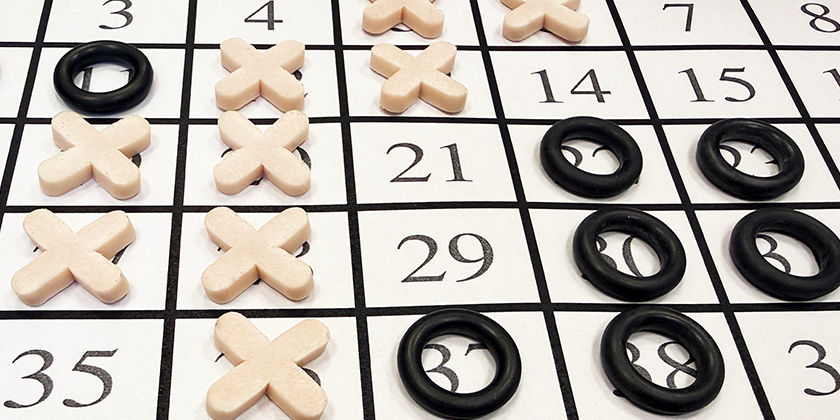
- An overhead transparency slide showing a checkboard grid with the squares numbered 1-64
- 30 tile spacers that create “Xs” when placed on a square
- 20 small gasket rings that create “Os” when placed on a square
Most hardware stores sell small gaskets and bags of plastic spacers (normally used to create grout lines when laying ceramic tiles). Other objects, such as pennies and paperclips, can also be used.
Preparation
Before class begins, arrange 30 “Xs” (the majority) and 20 “Os” (the minority) in a random pattern on the checkerboard so that 50 squares are covered and the remaining 14 squares are free.
Activity
Turn on the projector and tell students to imagine that the checkerboard is a community of 50 families and 14 unoccupied houses. Explain that for purposes of the demonstration, a square’s “neighbors” are the squares immediately adjacent to it (8 squares for interior houses, 5 squares for houses on the edge of the checkerboard, and 3 squares for houses in a corner position on the board).
Then tell students that:
- Each “X” wants to live in a neighborhood where most of its neighbors are majority members (a fairly modest preference—not a desire to live in an all-majority neighborhood).
- Each “O” wants to live in a neighborhood with at least two other minority neighbors (again, a very modest preference).
In other words, if an “O” has fewer than 2 other “Os” next to it, the “O” will be unhappy and want to move to an open square where it will be happy. Likewise, if the pieces surrounding an “X” are not mostly “Xs,” the “X” will want to move.
Then appoint a student to move unhappy pieces onto squares that will make them happy, and invite the rest of the class to call out moves (e.g., “Move the O on square 11 to square 29”), continuing until all pieces are happy.
In most cases, the end result will be a pattern of extreme segregation, even if students have a desire for integration.
Variations
If time permits, you may wish to vary “X” and “O” preferences to see how the results change (e.g., by having “Os” prefer to be near 3 other “Os rather than 2). It can also be interesting to vary the number and ratio of Xs and Os on the board. In addition, you might encourage students to use different coins or paper tokens to experiment outside of class with different minority-majority ratios and preference rules, reporting any interesting findings to the class next time.
Still another possibility is to assign students to go through the Web-Based Version on their own and write a brief reaction paper on: (1) what the results mean, and (2) how the results might be used to reduce segregation in daily life.
Notes
This lesson is not intended to suggest that segregation is accidental—merely that mild preferences at the individual level can lead to unanticipated or undesirable results at the societal level. More generally, the results show students that their personal preferences matter and can play a role in creating social patterns that they may not prefer, such as self-segregated campus dining areas.
Sources
Adapted from Chapter 4 (pp. 137-166) of Schelling, T. C. (1978). Micromotives and Macrobehavior. W. W. Norton and Company.
See also Rauch, J. (2002, April). Seeing around corners. The Atlantic, pp. 35-48.